

A certified fitness and nutrition specialist with over 10 years of experience, focused on practical, evidence-based advice for real-world training and supplementation.
If your day runs on coffee, you’re not alone. Across the UK, productivity often means caffeine. A flat white before emails. Another cup before lunch. Something stronger at 3pm when your brain starts to drift. It works – until it doesn’t. You feel alert, then restless. Focused, then foggy. Wired, but somehow tired.
The issue isn’t motivation. It’s instability.
Constant stimulation creates peaks and crashes. And that’s why more people are turning toward a calmer approach to performance – specifically combining lion’s mane and L-theanine.
Instead of pushing your nervous system harder, this pairing aims to smooth it. The goal isn’t intensity. It’s sustainable clarity — the kind that holds up across long workdays without leaving you tense or drained.
Using lion’s mane gummies daily and pairing them with L-theanine has become a practical way to build what many call a balanced nootropic stack for focus. It’s less about chasing a productivity high and more about building a steadier baseline.
To understand why that matters, we need to look at what’s actually happening inside your nervous system.
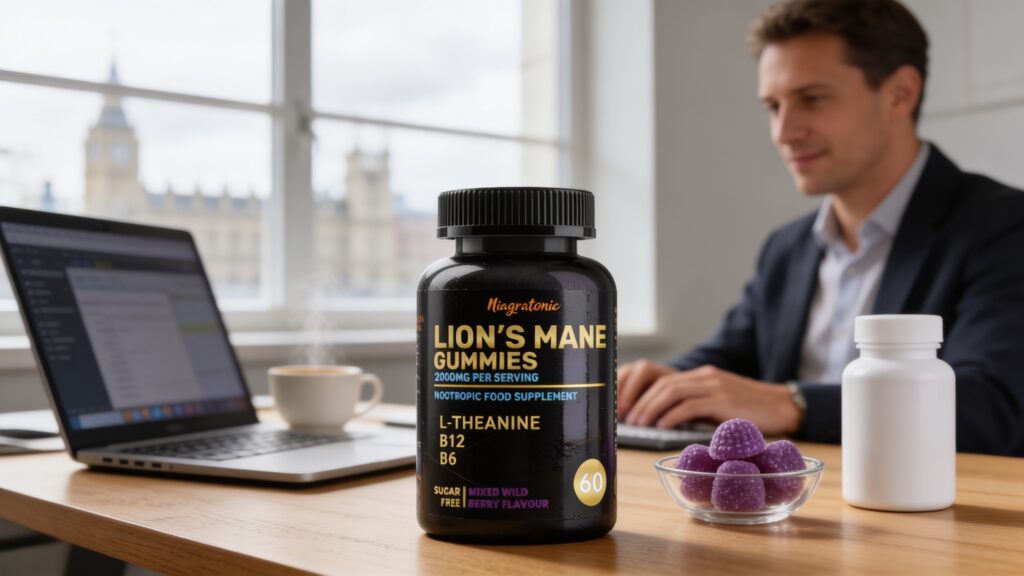
When your focus drops mid-afternoon, it’s easy to blame discipline. But more often, it’s overstimulation.
Caffeine blocks adenosine – the molecule that makes you feel tired. In small amounts, that’s useful. But over time, your body adapts. This is caffeine tolerance. You need more just to feel normal.
Meanwhile, your nervous system shifts toward constant sympathetic activation – the “fight or flight” state. That may feel productive in short bursts, but long-term it contributes to mental fatigue, shallow sleep, and reduced cognitive flexibility.
The modern UK work pattern – hybrid schedules, screen overload, constant notifications – amplifies this. That’s why natural focus supplements are gaining traction. The goal isn’t more stimulation. It’s better nervous system regulation.
Once you view productivity as a stability problem rather than a motivation problem, a non-stimulant approach starts to make sense.

Lion’s mane doesn’t feel like caffeine. You won’t get a rush. And that’s the point.
Much of the interest in lion’s mane benefits for brain health centres around its potential impact on Nerve Growth Factor (NGF). NGF supports the growth and maintenance of certain neurons. It’s different from BDNF – another growth factor often associated with exercise – but both play roles in neuroplasticity, your brain’s ability to adapt and form new connections.
Compounds in lion’s mane, particularly hericenones and erinacines, have been studied for their ability to stimulate NGF production.
A small human study published in Phytotherapy Research observed improved cognitive scores in older adults after 16 weeks of lion’s mane intake, with effects declining after supplementation stopped (Mori et al., 2009 – https://pubmed.ncbi.nlm.nih.gov/18844328/).
This suggests a cumulative effect rather than an acute boost.
Neuroplasticity, simply put, is your brain’s adaptability. Lion’s mane for productivity isn’t about short-term stimulation. It may be about supporting the environment that allows sustained focus to happen.
Whether taken as capsules or lion’s mane gummies, the key factor is consistency. Most people who notice benefits report subtle changes after several weeks – clearer thinking, better mental endurance, steadier mood.
It’s regulation, not stimulation.

If lion’s mane builds slowly, L-theanine works within the hour.
Found naturally in green tea, L-theanine promotes what researchers call relaxed alertness. It increases alpha brain wave activity – the state associated with calm concentration.
A study published in Nutritional Neuroscience showed increased alpha-wave activity roughly 45 minutes after ingestion (Gomez-Ramirez et al., 2008).
Mechanistically, L-theanine appears to modulate neurotransmitters including GABA, helping reduce excessive neural firing without sedating you.
That’s why tea feels different from coffee. Coffee can feel sharp and jittery. Tea feels smoother.
The caffeine and L-theanine stack uses this principle deliberately. Caffeine increases alertness. L-theanine reduces the anxious edge.
The result isn’t weaker stimulation – it’s more controlled stimulation.
For many people in high-pressure work environments, that distinction is everything.

The pairing isn’t just “long-term plus short-term.”
Your brain constantly manages excitation and inhibition. Too much excitation leads to restlessness. Too much inhibition leads to sluggishness. Cognitive stability depends on balance. L-theanine helps moderate immediate neural overactivation. Lion’s mane may support longer-term neural resilience.
Together, lion’s mane and L-theanine create what’s often described as a non-stimulant focus stack.
Not more intensity.
More consistency.
Productivity becomes about staying steady across hours – not spiking for 90 minutes and crashing.
When comparing lion’s mane gummies vs capsules, extract quality matters more than format. Look for fruiting body extract rather than just mycelium grown on grain. That’s where most active compounds are concentrated. In the UK, labelling transparency makes it easier to check sugar content in gummies – which is important if you’re monitoring intake.
Capsules offer precision. Gummies offer adherence. And because lion’s mane appears to work cumulatively, adherence may be the most important factor of all. If lion’s mane gummies fit naturally into your morning routine, that consistency can outweigh small format differences.
Lion’s mane is best taken consistently. Morning works for most people simply because it’s easy to remember.
L-theanine is more flexible.
Morning: pair with coffee for smoother alertness.
Afternoon: take alone to reduce stress without more caffeine.
Many people ask, can you take lion’s mane and L-theanine together? Yes – they’re commonly combined. Precision timing matters less than routine.
A lion’s mane stack can be expanded, but minimalism usually wins. Rhodiola may support stress resilience during demanding periods. Magnesium can support recovery and sleep quality.
Ashwagandha may help modulate stress response. But piling on ingredients often creates diminishing returns. If you’re building nootropics without caffeine, the foundation should feel stable before layering complexity. Caffeine moderation remains critical. Even the best stack can’t outcompete excessive stimulant use.
This isn’t for extreme biohackers.
It suits:
Students juggling revision and part-time work
Remote workers battling screen fatigue
Gym-goers reducing high-stim pre-workouts
Creators managing digital overload
In the UK’s caffeine-heavy work culture, steadier focus can be more valuable than intensity.
Both ingredients have favourable safety profiles in healthy adults. Lion’s mane has low reported toxicity. L-theanine is widely regarded as safe and non-habit forming. If pregnant, breastfeeding, or on medication, consult a healthcare professional.
Moderation matters.
The goal is regulation – not escalation.
If you’re looking for a productivity high, this isn’t it.
If you’re looking for stability – fewer crashes, calmer focus, reduced jitteriness — then lion’s mane and L-theanine offer a rational approach.
The effects are subtle and cumulative. You may not notice a dramatic shift. Instead, you may realise you’re less reactive, more consistent, and able to sustain focus without relying on escalating caffeine.
And in a world that constantly pushes stimulation, that steadiness can be powerful.
Yes. Many people use this stack daily. Lion’s mane appears to work best with consistency and cumulative intake. L-theanine can also be used daily or situationally. Moderation remains important.
Most people report subtle changes after 2-4 weeks. The effect appears cumulative rather than immediate.
Yes. It functions as a non-stimulant focus stack. L-theanine promotes calm alertness even without coffee.
They can be, provided extract quality is high and fruiting body is used. Always check sugar content and transparency.
L-theanine may support relaxed alertness. Lion’s mane has been studied for mood-related effects. However, this is not a medical treatment and should not replace professional care.