

A certified fitness and nutrition specialist with over 10 years of experience, focused on practical, evidence-based advice for real-world training and supplementation.
If you’ve been training for more than five minutes, you’ve probably heard:
“Just take 5 grams and don’t overthink it.”
But then you Google creatine dosage or how much creatine per day UK and suddenly you’re deep into loading phases, bodyweight formulas, cycling protocols and kidney myths.
I’ve been lifting for over three years now – strength training, glutes, a bit of conditioning – and I’ve tested different approaches myself. So here’s a no-nonsense guide to creatine dosage, explained the way I’d tell a gym friend.
We’ll cover:
How much creatine per day you actually need
Whether you need a loading phase
How to calculate dosage by bodyweight
When to take it
And why consistency (and format) matters more than you think

Creatine is one of the most researched sports supplements in the world. It helps:
Increase strength output
Improve power in short, intense sets
Support better recovery between sets
Give muscles that slightly fuller, firmer look
If you train 3-5 times per week and want to progressively lift heavier, your creatine dosage matters more than the brand hype.
Let’s keep this simple.
For most UK gym-goers aged 18-35, the standard creatine dosage is:
3–5 grams per day, every day.
That’s it.
Under 70kg → 3g is often enough
70–100kg → 5g is ideal
And yes — you take it daily, even on rest days.
When people ask how much creatine per day, the answer almost always lands in that 3-5g range.
If you want to be precise, there’s a formula:
0.03g per kg of bodyweight
Examples:
60kg → 1.8g (realistically rounded to 3g)
75kg → 2.25g (most people still take 3–5g)
90kg → 2.7g (commonly 5g daily)
So yes, technically you can calculate it. But in real-world gym life? Most people just stick to a consistent 5g and focus on training hard.
A loading phase typically looks like:
20g per day
Split into 4 doses
For 5-7 days
Then drop to 3-5g daily
This saturates muscle creatine stores faster.
But here’s my honest opinion: unless you’re prepping for something specific, it’s not essential.
You can simply take your normal daily creatine dosage and your muscles will saturate within 3-4 weeks anyway. Slightly slower? Yes. But far simpler.
I’ve personally never bothered with loading and still progressed consistently.
Timing isn’t as critical as people think.
You can take it:
Post-workout
With a meal
In the morning
In the evening
The key is consistency.
I usually take mine after training or with breakfast on rest days. What matters most is that you don’t skip it.
Most research is based on creatine monohydrate.
It’s:
Affordable
Effective
Well studied
If you’re comparing formats, you might want to read:
→ Creatine Gummies vs Powder
And if you’re wondering whether alternative formats are actually effective:
→ Do Creatine Gummies Work?
The dosage doesn’t really change – it’s still about hitting your 3-5g daily.
Short answer: no.
There’s no strong evidence suggesting you must cycle off creatine if you’re healthy and using a standard creatine dosage.
Many people in the UK take it year-round.
If you ever stop, your muscle creatine levels will gradually return to baseline – but there’s no “dependency” effect.
Most people tolerate creatine very well.
Possible minor effects can include:
Mild water retention
Slight increase on the scale (intramuscular water)
Occasional digestive discomfort (usually from high doses or poor-quality powder)
If you stick to 3-5g per day, side effects are uncommon.
Hydration matters. Drink enough water – especially if you train intensely.
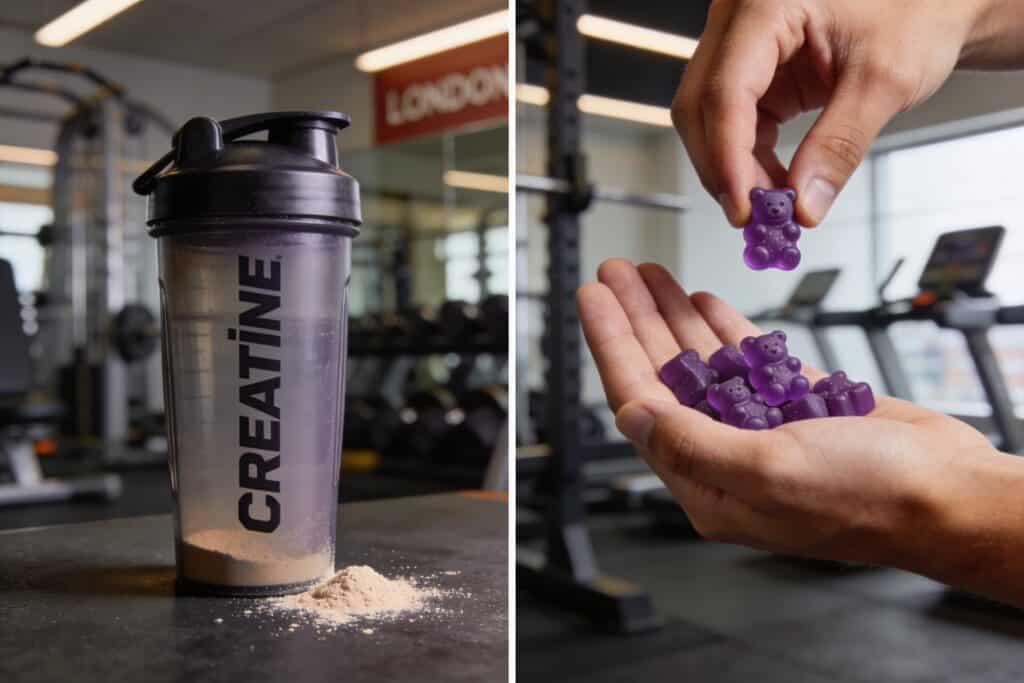
Here’s where things get practical.
With powder, you need to:
Measure accurately
Mix daily
Carry a shaker
Deal with clumping or taste
With (Creatine Gummies), the dosage is pre-measured. No scoops. No guesswork.
From a pure science perspective, your muscles don’t care about the format – they care about the amount.
But from a consistency perspective? Format absolutely matters.
If gummies make it easier to hit your daily creatine dosage without skipping days, that’s a win.
Especially if you’re busy, training after work, or just hate chalky textures.
If you’re overthinking creatine dosage, here’s your simplified rule:
Take 3-5g daily
Don’t stress about timing
Skip loading unless you want faster saturation
Stay consistent
And choose a format that you’ll actually stick to long-term.
Because the best creatine dosage is the one you don’t forget to take.
Most UK gym-goers should take 3-5g per day. Heavier individuals (over 80kg) typically benefit from 5g daily.
No. 5g per day is considered a standard creatine dosage and is widely used in research and practice.
Not necessarily. Women can follow the same 3-5g guideline. Bodyweight may influence the exact amount, but the difference is usually small..
It’s optional. Loading speeds up muscle saturation, but it isn’t required for results.
Yes. Many people use creatine year-round without cycling.